
Medieval European Expulsions of Jews
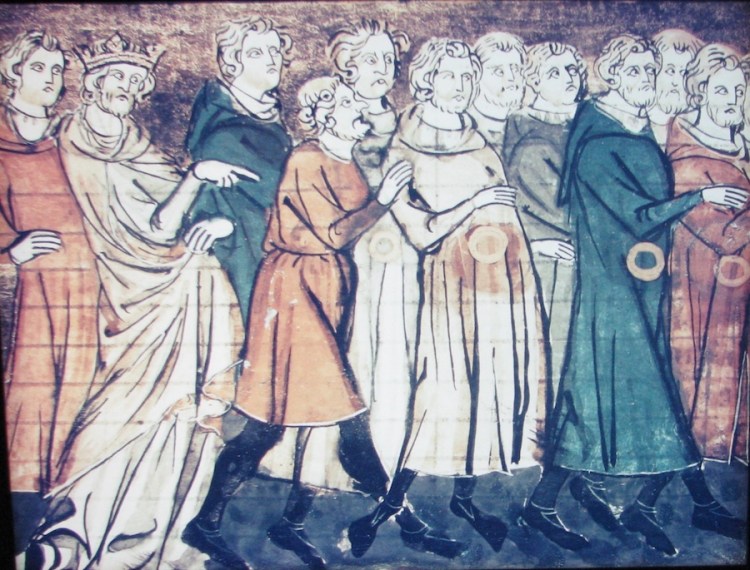
In an era of social and economic upheaval and geopolitical competition, political leaders sought to identify stable income sources and expand their administrative intrusion while satisfying a range of interests, including those of the state itself. During this epoch, communities of Jews could be assets to governments. The Holy Roman Emperor farmed out rights to govern, protect, and tax local Jews as special subjects of the emperor. By the late Middle Ages, emperors, landgraves, guilds, and town councils wrestled over determining the relevant authority over Jews in a patchwork landscape of overlapping jurisdiction. German territories were particularly inhospitable for Jews from the 15th century onward, as authority over Jews became more hotly contested. If city rulers faced both reasons for expulsion and reasons against expulsion, then where, when, and why did medieval and early modern cities in the Holy Roman Empire expel their Jewish residents?
I translated and digitized records in Geschichte der Juden im Mittelalter von der Nordsee bis zu den Südalpen (Haverkamp 2002), producing a spatial database including over 800 cities in the period 1000-1520. Geschichte der Juden covers Jewish settlement and persecutions in the western Holy Roman Empire (historic Ashkenaz) based on the encyclopedia Germania Judaica (Maimon et al. 1987-2003) and the Deutsche Städtebuch. The project uses Bayesian logistic regression, spatial discrete-time event-history regression, and comparative-historical methods.
This research has received support from the Deutscher Akademischer Austauschdiesnt (DAAD, German Academic Exchange Service) and the University of Washington Stroum Center for Jewish Studies.
Research Products
Ideas and findings have been presented at meetings of the American Sociological Association; Social Science History Association; Association for the Study of Religion, Economics, and Culture; Association for the Sociology of Religion; and at the Arye Maimon Institute for Jewish History at Universität Trier and the Department of Economic History at the London School of Economics and Political Science.
Journal Articles
Kerice Doten-Snitker. Forthcoming. “The Temporal and Spatial Structure of Medieval Expulsions of Jews.” Comparative Political Studies. doi: 10.1177/00104140241269956 (working paper on SocArXiv, replication materials)
Kerice Doten-Snitker. 2022. “Contexts of State Violence: Jewish Expulsions in the Holy Roman Empire.” Social Science History 45(1):131-163. doi: 10.1017/ssh.2020.39 (working paper on SocArXiv) Winner of the Social Science History 2022 Graduate Student Paper Prize
Other Venues
“BREXIT Britain, Medieval Echoes.” Monitor: Global Intelligence on Racism, Issue 8, May-June 2022. Magazine article; Video
Medieval Political Competition and the Attack on Ethnoreligious Diversity – University of Washington Dissertation
“Expect Iteration for Historical Projects” – States, Power, & Societies: ASA Political Sociology Section Newsletter, Summer 2019, 10–11. Newsletter article
“Debunking the myth of ‘elite Jews’ in medieval Europe” – UW Stroum Center for Jewish Studies E-Journal Blog post
“How anti-Semitism was used to gain political power in medieval Germany” – UW Stroum Center for Jewish Studies E-Journal Blog post
 Kerice Doten-Snitker